That’s the short version. Here’s what each of those actually takes to build, and why the window to get ahead of this is open right now rather than in six months.
Why this matters for agencies specifically
Clients are going to ask about this whether or not an agency has a point of view ready. ChatGPT Ads has been live since February, self-serve since May, and it’s been covered widely enough that a marketing director who reads industry news has probably already heard of it.
That creates a real, if temporary, differentiation window. Most agencies haven’t run a live campaign here yet. The ones that have even a small test behind them, with real numbers instead of secondhand reporting, get to answer the client’s question with data instead of speculation.
It’s also a plausible new revenue line, not just a talking point. A self-serve platform with no minimum spend is exactly the kind of low-risk entry point agencies can wrap into an existing retainer without asking a client to commit real budget upfront. For how this compares to organic AI visibility work specifically, see ChatGPT Ads vs GEO.
What’s changed that lowers the barrier to entry
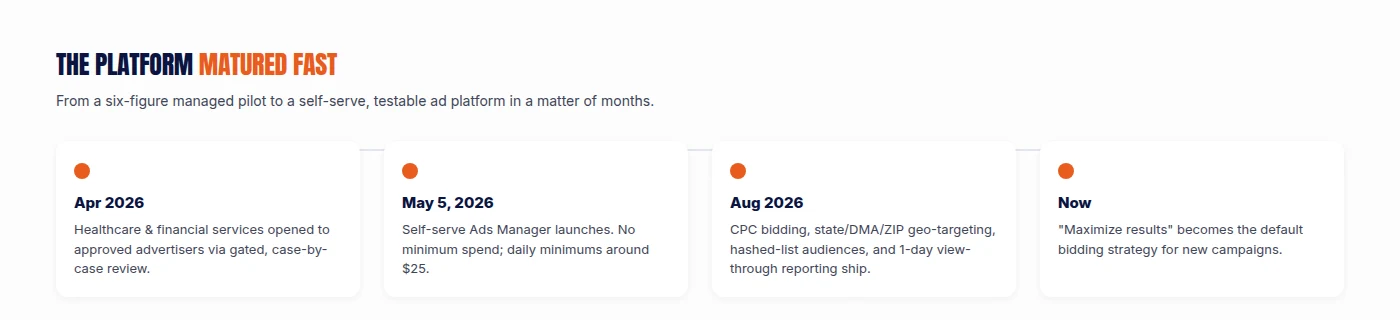
The earlier managed pilot required a monthly minimum in the tens or hundreds of thousands of dollars, which put it out of reach for most agency clients entirely. That’s gone. The self-serve Ads Manager, live since May 5, removed the spend floor completely, with reported daily minimums now around $25.
CPC bidding is available alongside the original CPM model, and an automated “Maximize results” strategy became the default approach for new campaigns as of August, meaning OpenAI’s bidding algorithm handles adjustments rather than requiring a fixed manual bid. Targeting has also matured past the country-only stage: US state, DMA, and ZIP-level geo-targeting shipped in August, along with custom audience uploads from hashed email and phone lists.
None of that makes this a mature platform yet. But it makes it a genuinely testable one, which is the bar that matters for a first client pilot.
Building a test framework
Start with a defined, bounded budget, not an open-ended commitment. A few thousand dollars over a month is enough to see real click and conversion data without asking a client to bet a meaningful chunk of their paid media spend on an unproven channel.
Pick the right early candidates carefully. OpenAI’s category policy has shifted since launch, and it’s worth understanding the current shape of it before pitching any specific client vertical. See can small businesses advertise on ChatGPT for the fuller eligibility breakdown.
Political advertising, gambling, alcohol and tobacco, adult and dating content, and illegal or dangerous goods remain flatly prohibited, with no path to approval. Healthcare and financial services were categorically excluded at launch but opened in April 2026 to approved advertisers through a case-by-case, gated review process, meaning a health or finance client can potentially run ads, but getting there takes more than filling out a form. Legal services access is narrower, and reporting on its exact status has been mixed, so confirm current eligibility directly with OpenAI before pitching a client in that vertical specifically.
On top of category eligibility, OpenAI keeps ads out of sensitive conversational contexts entirely, regardless of the advertiser’s category. A health insurance ad might be approved at the account level and still never serve, because it can’t appear near a conversation about a medical symptom or a mental health topic. That’s a different kind of gate than agencies are used to managing on Google or Meta, where category approval and placement eligibility are mostly the same decision.
For a first test, mainstream consumer and B2B categories, the kind of businesses that would already run cleanly on Google or Meta, are the safer starting point. Save the gated verticals for a second wave once the account-level approval process is understood.
The measurement stack
Native reporting inside Ads Manager covers impressions, clicks, spend, CTR, average CPC or CPM, and conversions, tracked through a pixel and a server-side Conversions API. One-day view-through conversion reporting was added in August. For a full breakdown of how to structure this, see how to measure ROI from ChatGPT Ads.
What it doesn’t give you yet is granular demographic breakdown or conversation-level detail, both by design, since OpenAI aggregates reporting to protect conversation privacy. That means connecting ChatGPT Ads performance to GA4 or a client’s CRM matters more here than it might on a more mature platform, because the native dashboard alone won’t tell the whole story.
A few third-party attribution platforms, including Triple Whale and Hightouch, now support ChatGPT Ads integrations. Building a habit of piping ChatGPT Ads conversion events into whatever attribution tool a client already trusts is worth doing from campaign one, not retrofitting after the fact once a client asks for a real ROI number.
Positioning it to clients
Frame ChatGPT Ads as a test sitting next to GEO and AEO investment, not competing with it for budget. That’s true on the merits, not just as a sales angle. Ads reach only Free and ChatGPT Go tier users; anyone on a paid ChatGPT subscription only ever sees organic answers, so GEO work remains the only way to reach that audience regardless of ad spend.
The two also generate different kinds of value on different timelines. Ads produce a fast, testable read on messaging and offers. GEO investment compounds slowly, building citation likelihood that persists across ChatGPT, Perplexity, Gemini, and Claude at once, without ongoing spend. A client hearing both framed honestly, rather than one pitched as a replacement for the other, tends to trust the recommendation more.
The real risks
Be straight with clients about what’s still unproven. Targeting granularity, while improved, still lags well behind Google Ads or Meta. ROI benchmarks are thin, since the self-serve platform is only a few months old. And the category and context exclusions mean an agency could sink real setup time into a client vertical only to discover late in the process that a specific offer or context won’t clear review.
There’s also a broader trust question worth watching rather than ignoring. OpenAI has stated publicly, including a co-founder’s on-record comment in August, that advertisers cannot buy influence over ChatGPT’s answers. That’s a stated policy, not something independently audited, and reports of a broader multi-state attorney general inquiry touching on that claim have surfaced. It likely doesn’t change how an agency runs a campaign today, but it’s a reasonable thing to keep an eye on before building a long-term strategy around the platform’s current promises. For more on how the ad and answer systems relate mechanically, see will ChatGPT Ads affect which brands appear in AI answers.
A readiness checklist
Set up an Ads Manager account and run a small, real test campaign before a client asks. Firsthand data beats secondhand reporting in every client conversation.
Confirm current category and context eligibility for any specific client vertical before pitching it, since the policy has already changed twice this year. Build the Conversions API connection into a client’s existing attribution stack as part of setup, not as an afterthought. And prepare the GEO-plus-ads framing now, so it’s ready the first time a client brings this up unprompted, which is likely to happen sooner than most agencies expect.
FAQ
Do agencies need special access to manage ChatGPT ad campaigns for clients?
No special partnership is required for the self-serve tier. Any eligible business can create an account at ads.openai.com. Larger managed relationships existed during the earlier pilot phase, but the self-serve launch removed that gate.
What client verticals are excluded from ChatGPT advertising?
Political advertising, gambling, alcohol and tobacco, adult and dating content, and illegal or dangerous goods are fully prohibited. Healthcare and financial services were excluded at launch but opened in April 2026 to approved advertisers through case-by-case review; legal services access is narrower and reporting on its status has been mixed. Ads also can’t appear near sensitive conversational contexts like health or mental health topics, regardless of the advertiser’s category.
How should agencies price ChatGPT Ads management given how new the platform is?
Most agencies are treating early ChatGPT Ads work as a test-and-learn engagement, often bundled into existing paid media retainers rather than priced as a standalone premium service, given the platform’s current limits on targeting granularity and the lack of long-term ROI benchmarks.
Can a health or finance client advertise on ChatGPT now?
Potentially, but it’s not automatic. OpenAI opened these categories to approved advertisers in April 2026 through a gated, case-by-case review process, and ads still can’t appear near sensitive conversations even for an approved advertiser. Confirm current eligibility directly before committing setup time to a client in either vertical.