What Is G2 AEO Insights, Exactly?
G2 AEO Insights is an analytics dashboard built for vendors, not buyers. It gives a software company visibility into how its own product is performing inside AI-powered buying conversations: how often ChatGPT, Gemini, or other AI tools mention the product when someone asks a category-related question, which competitors get named in the same answers, and how that visibility trends over time. It exists because G2 review content, comparison pages, and badges are heavily cited by AI models when they answer software-buying questions, so a vendor’s G2 presence directly shapes what AI tools recommend to potential customers.
If you’re not selling AEO software but shopping for it, this specific feature isn’t the one you want. What you’re almost certainly looking for is G2’s public Answer Engine Optimization (AEO) Tools category, the page where buyers browse, filter, and compare AEO vendors using verified reviews and G2’s Grid rankings. That’s the shopping tool. AEO Insights is the backstage analytics vendors use to track their own visibility, and the two get mixed up constantly because they share the same “AEO” name inside the same platform.
What Is G2’s Answer Engine Optimization (AEO) Tools Category?
This is G2’s public, buyer-facing category for AEO and GEO (Generative Engine Optimization) software, and it’s grown fast. It launched in March 2025 with just seven listed products and had grown more than 2,000%, to over 150 products, by January 2026, according to G2’s own reporting. The category earned its first official G2 Grid Report in the Winter 2026 Reports cycle, once it crossed G2’s maturity thresholds for review volume. By August 2026 the category had grown well past that, with several hundred AEO and GEO products now listed.
That growth tracks a real shift in buyer behavior. G2’s own August 2026 survey found that roughly half of B2B software buyers now start their purchasing research inside an AI chatbot instead of a traditional Google search, with ChatGPT the preferred assistant for the large majority of them. As more buying journeys start inside AI tools, more software companies are investing in AEO, which is exactly why this G2 category has grown so quickly in such a short window.
What Does the AEO Tools Category Include?
The category includes software that helps brands track and improve visibility inside AI-generated answers. That spans a few distinct but related functions. Some tools focus primarily on monitoring: they scan AI engines for prompts relevant to your industry and report when and how often your brand gets mentioned or cited.
Other tools in the category go further, offering competitive benchmarking (how often you’re cited versus named competitors), content recommendations (what to publish or restructure to improve citation odds), and sentiment analysis of how your brand is described when it does appear in an AI answer. A smaller number of products bundle AEO tracking with broader GEO or traditional SEO tooling, which is why you’ll sometimes see overlap between this category and adjacent ones on G2.
Each listed product carries a G2 profile with a description, screenshots, pricing information where vendors disclose it, and, most importantly, a running feed of verified user reviews. That review layer is what actually makes the category useful: it isn’t marketing copy from the vendors themselves, it’s buyer-submitted feedback moderated by G2’s verification process.
Top AEO Software Products Featured on G2
Rankings in a category this new shift constantly as reviews accumulate and new vendors launch, so treat any snapshot as exactly that: a snapshot. As of August 2026, products with strong ratings and meaningful review volume in G2’s AEO Tools category include Brandlight AI, Peec AI, Visby AI, Birdeye, SE Ranking, Profound, and Semrush, spanning both AEO-specific startups and larger marketing platforms that added AI-visibility features. Review counts vary enormously across that list too, from newer entrants with a couple dozen reviews to established platforms with thousands.
Rather than treating any list as fixed “winners,” the more useful approach is to visit the category page directly and sort by what matters to your situation: company size, industry, and use case. G2 updates its Grid positioning (Leaders, High Performers, Contenders, Niche) on a rolling basis, so a list compiled today may look meaningfully different in a few months, especially in a category growing this fast.
How G2 Evaluates and Scores AEO Tools
G2’s scoring methodology is consistent across every category on the platform, including AEO Tools. It combines a “Satisfaction Score,” built from review ratings across dimensions like ease of use, quality of support, and likelihood to recommend, with a “Market Presence Score,” built from company size, employee count, social presence, and review volume.
These two scores together plot each product onto the G2 Grid, which splits vendors into four quadrants. Leaders have both high satisfaction and high market presence. High Performers have strong satisfaction but haven’t yet built large market presence, which is often true of newer, highly rated AEO startups. Contenders have presence but lower average satisfaction, and Niche products serve a narrow use case well without broad market reach.
For a category this new, that quadrant placement matters more than it would in a mature market, because market presence lags product quality. An excellent tool launched a year ago may still show as a High Performer rather than a Leader, simply because it hasn’t had time to accumulate the review volume and market footprint the Leaders quadrant requires.
Why This Matters for Software Buyers
For a founder with limited time, G2’s AEO category solves a real problem, and can save you from the harder build-versus-buy decision entirely: the AEO tooling space is crowded and full of vendors making similar-sounding claims. Marketing pages alone don’t tell you whether a tool’s citation tracking is accurate, whether its dashboard is usable day to day, or whether support responds when something breaks.
Verified reviews fill that gap. A founder can filter reviews by company size, read specific complaints and praise, and get a realistic sense of implementation effort before ever booking a demo. That’s especially valuable in a category where the underlying technology is harder to verify from the outside than, say, whether an email tool sends emails.
How to Use G2’s AEO Category to Choose a Tool
Start by filtering the category by your company size and industry, since an AEO tool built for enterprise marketing teams will feel bloated and expensive for a five-person startup, and vice versa. Read the negative reviews first. They surface the friction points a vendor’s own site will never mention, like slow support response times or reporting gaps.
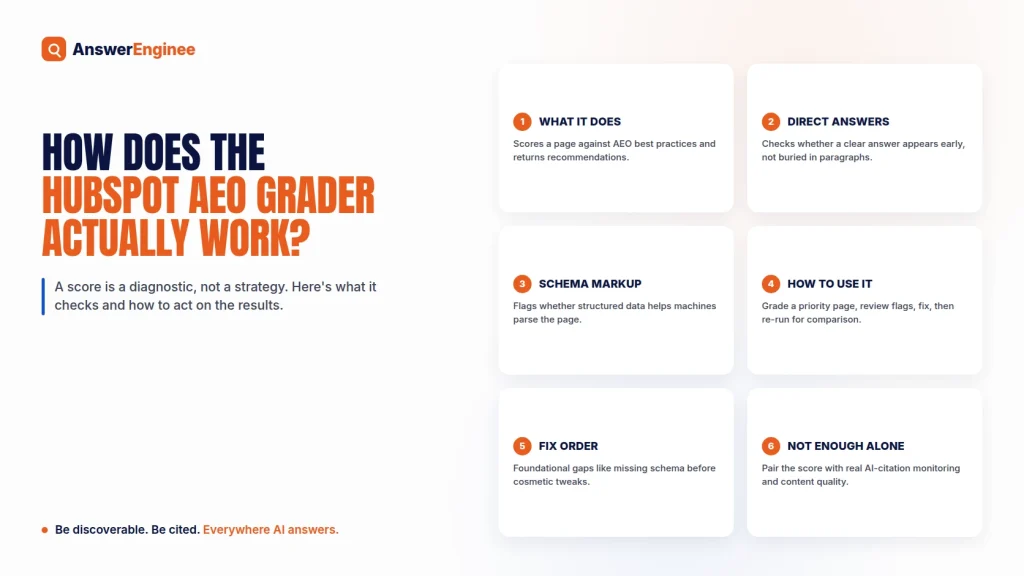
Next, compare the specific capabilities that matter for your situation, the same way you’d weigh one AEO vendor against another: how many AI engines does the tool actually monitor, how often does it refresh data, and does it include competitive benchmarking or just your own brand’s mentions. Finally, treat the G2 category as a shortlisting tool rather than a final decision-maker. Use it to narrow ten options down to three, then validate those three with actual demos and trial periods before committing budget.
Frequently Asked Questions
What is AEO Insights on G2?
Strictly speaking, G2 AEO Insights is a vendor-facing analytics dashboard that shows software companies how their product surfaces inside AI-generated buying conversations, including competitor mentions and visibility trends. Most people searching this phrase are actually looking for G2’s public Answer Engine Optimization (AEO) Tools category, the buyer-facing page where you can browse, filter, and compare AEO software using verified reviews and G2’s Grid rankings.
Is AEO Insights a company on G2?
No. This is a common misreading. “AEO Insights” is G2’s name for a vendor analytics feature, and “Answer Engine Optimization (AEO) Tools” is G2’s name for the buyer-facing software category, not a company in either case. The category aggregates reviews, ratings, and comparisons for dozens of AEO tool vendors that compete in the same space, similar to how G2’s “CRM Software” category isn’t a company either, just an organizing label for every CRM product listed under it.
How does G2 rate AEO tools?
G2 rates AEO tools using two combined scores: a Satisfaction Score built from verified user reviews covering ease of use, support quality, and likelihood to recommend, and a Market Presence Score built from company size, review volume, and broader market footprint. These two scores place each product on the G2 Grid, which sorts vendors into four quadrants (Leaders, High Performers, Contenders, and Niche) and gives buyers a quick visual sense of where each tool stands relative to competitors.
Which AEO tools have the best G2 reviews?
As of August 2026, products with strong ratings in G2’s AEO Tools category include Brandlight AI, Peec AI, Visby AI, Birdeye, SE Ranking, Profound, and Semrush, though rankings shift regularly as new reviews are submitted and new vendors join. The most reliable approach is to visit the AEO Tools category directly on g2.com, where you can sort by current rating, filter by company size and industry, and see the most up-to-date Grid positioning rather than relying on a snapshot that may no longer reflect the current market.
Is G2 reliable for AEO buying decisions?
G2 reviews are generally reliable as a starting point for shortlisting AEO vendors, since they reflect real customer experience rather than vendor marketing claims. That said, they shouldn’t be the only input into a purchasing decision. Supplement G2 research with live product demos, free trials where available, and direct conversations with vendor sales or support teams, since a tool’s fit for your specific industry, team size, and technical setup often depends on details a star rating alone can’t capture.
Key Takeaways
- “G2 AEO Insights” is actually a vendor analytics feature; most buyers searching this phrase want G2’s public Answer Engine Optimization (AEO) Tools category instead.
- The AEO Tools category launched in March 2025 with 7 products and grew more than 2,000%, to 150+, by January 2026, with several hundred listed by August 2026.
- That growth tracks a real shift in buyer behavior: roughly half of B2B software buyers now start research in an AI chatbot instead of Google, per G2’s own survey.
- G2 scores products using a Satisfaction Score and a Market Presence Score, plotted on the four-quadrant G2 Grid.
- Rankings shift often in this fast-growing category, so check the live category page rather than relying on a static list.
- Use G2 to shortlist vendors, then validate finalists with demos and trials before making a purchasing decision.