If you have seen all three terms used in the same sentence and come away more confused than when you started, you are not alone. Marketers have started using SEO, AEO, and GEO somewhat loosely, sometimes as synonyms, sometimes as competing frameworks. They are neither. Each term describes a different piece of how a brand gets discovered today, and understanding where one ends and the next begins makes it much easier to decide where to actually spend your time.
What Is SEO?
Search Engine Optimization is the practice of getting a webpage to rank higher in traditional search engine results, primarily Google. SEO tactics include keyword research, on-page optimization (title tags, headers, internal linking), technical performance (page speed, mobile usability, crawlability), and off-page signals like backlinks from other reputable sites. The goal of SEO is straightforward: when someone types a query into a search box, your page appears as high as possible on the results page, ideally in the first few organic positions.
SEO has been the dominant discipline in digital marketing for two decades, and it remains foundational. Search engines still handle billions of queries a day, and a well-optimized site still captures a meaningful share of that traffic. What has changed is that search results are no longer the only place people go to get answers.
What Is AEO?
Answer Engine Optimization is the practice of structuring content so that AI systems, ChatGPT, Perplexity, Google’s AI Overviews, and similar tools, cite your brand or your content when answering a user’s specific question. Where SEO optimizes for ranking position on a results page, AEO optimizes for being the source an AI engine pulls from and names when it generates a direct answer.
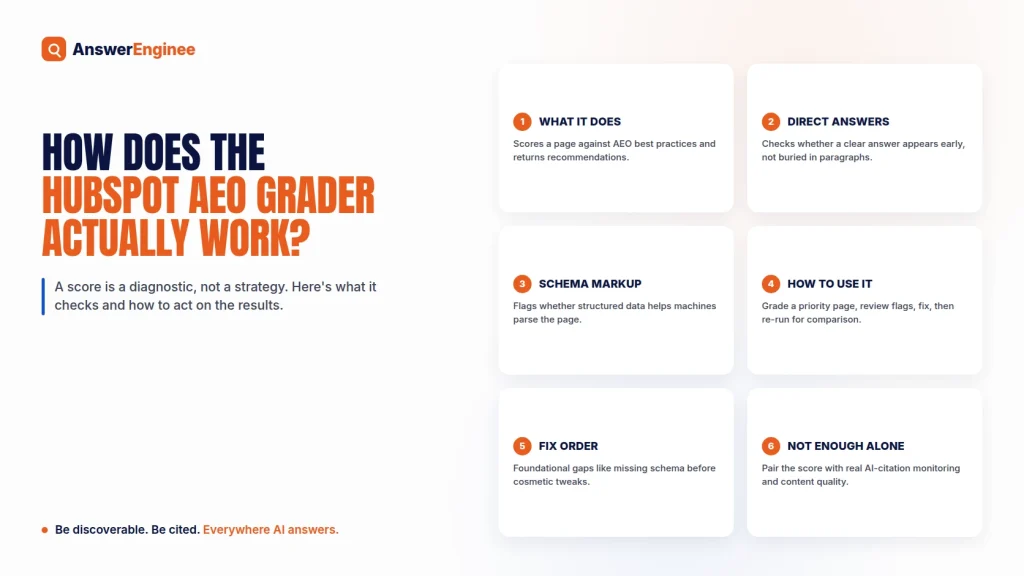
The tactics differ accordingly. AEO leans heavily on direct-answer formatting (stating the answer to a likely question in the first sentence or two of a section), structured data and schema markup (which helps AI systems parse what a page is actually saying), and clear, quotable phrasing that an AI model can lift cleanly into a generated response. Success in AEO is measured not by a ranking position but by whether and how often your brand shows up as a cited source across a defined set of prompts.
What Is GEO?
Generative Engine Optimization is the broadest of the three terms. It covers the full range of ways a brand can appear in AI-generated content, not just as a citation answering one specific question, but in summaries, comparisons, recommendations, and conversational responses where an AI system describes, ranks, or recommends a brand without necessarily quoting it directly.
Think of the difference this way: AEO is concerned with a narrow, answerable question, “what is the best project management tool for a five-person team?”, and whether your brand gets named in the direct response. GEO is concerned with the much wider set of situations where a brand’s reputation, positioning, and content footprint shape how an AI system talks about it at all, even in contexts where no single direct question was asked. A GEO strategy considers brand mentions, sentiment, how consistently a brand is described across different AI platforms, and how a company’s broader content presence, not just its FAQ pages, shapes AI-generated output.
How the Three Relate to Each Other
The cleanest way to understand SEO, AEO, and GEO is as nested in scope, not as three competing strategies you have to choose between.
SEO feeds AEO. Many of the same fundamentals that help a page rank in Google, clear structure, credible sourcing, well-organized headers, also help AI models understand and trust that page enough to cite it. A page that never ranked in traditional search and has no external validation is unlikely to get cited by an AI engine either. So a solid SEO foundation makes AEO easier, not obsolete.
AEO, in turn, is a subset of GEO. Getting cited for a specific direct question is one visible, measurable slice of the larger goal, being described favorably and accurately across the full range of AI-generated content. A brand can nail its AEO game, winning citations on ten well-chosen prompts, while still having gaps in the broader GEO picture, for instance being described inaccurately in a longer AI-generated comparison article that never quotes a single specific answer directly.
Here is a side-by-side comparison of how the three differ across a few important dimensions:
| Dimension | SEO | AEO | GEO |
|---|---|---|---|
| What it optimizes for | Ranking position on a search results page | Being cited as the direct answer to a specific question | How a brand appears across all AI-generated content and outputs |
| Primary channel | Traditional search engines (Google, Bing) | AI answer engines (ChatGPT, Perplexity, AI Overviews) | All AI platforms, including generative summaries and recommendations |
| Key tactics | Keyword research, backlinks, technical SEO, on-page optimization | Direct-answer content, schema markup, structured FAQ formatting | Broad content strategy, brand consistency, sentiment management, cross-platform presence |
| How success is measured | Search rankings, organic traffic, click-through rate | Citation frequency and accuracy across tracked prompts | Brand sentiment, share of voice, and consistency across AI-generated descriptions |
What Is AEO and GEO in Marketing Practice?
In day-to-day marketing work, AEO and GEO both describe a shift away from ranking pages and toward being recommended, cited, or described favorably by an AI system rather than a search algorithm. In practice, this means a marketing team now has to think about two additional questions beyond “does this page rank”: does this page get cited when an AI engine answers a related question, and how does this brand get described when an AI system talks about the category more broadly, even without a specific query pointing at it?
AEO work tends to be concrete and project-based: pick a set of high-value prompts, rewrite pages to answer them directly, add schema, track citations. GEO work is more ongoing and diffuse: monitor how a brand is described across AI platforms over time, address inaccuracies where they appear, and build a broader content footprint that gives AI systems more accurate material to draw from. Most marketing teams find it easier to start with the narrower, more measurable AEO work before expanding into full GEO monitoring.
Which Should You Prioritize First?
For most businesses, the sequence should follow the nested relationship described above. Keep SEO as the foundation. It still drives real traffic, and much of what makes a page rank well also makes it more likely to be cited by an AI engine. Layer in AEO fundamentals next: direct-answer formatting and schema markup are concrete, implementable, and measurable in a way that makes them a natural second step. Only after AEO basics are solid does it make sense to expand into the broader, harder-to-measure work of full GEO monitoring and brand-sentiment management across AI platforms.
Trying to tackle all three at once, especially for a small team, usually means none of them get done well. Start with the foundation, add the next layer once it is solid, and expand outward from there.
Frequently Asked Questions
What is the difference between SEO, AEO, and GEO?
SEO ranks pages in traditional search results. AEO gets content cited directly by AI engines when they answer specific questions. GEO is the broadest term, covering how a brand appears across all AI-generated outputs, including summaries and recommendations that go beyond a single direct answer.
What is AEO and GEO in digital marketing?
In digital marketing, AEO and GEO both describe optimizing for AI-driven discovery rather than traditional search rankings. AEO focuses narrowly on direct question-and-answer citations, while GEO covers the wider range of ways AI systems represent a brand.
What is AEO, GEO, and AI search collectively?
Together, AEO, GEO, and AI search describe the broader shift from ranking in search results toward being recommended, cited, or described favorably by AI systems, whether through a direct answer, a summary, or a wider recommendation.
Which should I prioritize: SEO, AEO, or GEO?
Most businesses should keep SEO as the foundation, add AEO fundamentals (direct answers, schema markup) next since they are concrete and measurable, and then expand into broader GEO practices once the AEO basics are solid.
Key Takeaways
- SEO ranks pages in traditional search results; AEO gets content cited directly by AI engines answering specific questions; GEO is the broadest term, covering all AI-generated brand representation.
- SEO and AEO are not competitors. Strong SEO fundamentals make content easier for AI engines to trust and cite.
- AEO is a subset of GEO. Winning citations on specific prompts is one measurable piece of a much larger picture.
- Use the comparison table above to quickly see how each discipline differs on tactics, channel, and how success gets measured.
- Most businesses should build SEO first, layer in AEO next since it is concrete and measurable, and expand into full GEO monitoring last.
- Trying to run all three strategies at once, especially with a small team, usually means none of them get the attention they need.