Both are useful. Neither is the same thing as citation rate, which measures whether your specific brand is the one cited once an AI Overview shows up. Occupancy tells you how much of the battlefield AI Overviews have taken. Citation rate tells you whether you’re winning within it. For the full four-metric audit built around this distinction, see how to measure AI Overview visibility in an SEO audit.
Usage 1: query-level occupancy
This is the more common meaning. Query-level occupancy is the percentage of your tracked keyword set that currently shows an AI Overview at all, regardless of whether you’re cited when it does. It’s a category or topic-level exposure metric, not a brand-level one.
A content area with high query-level occupancy, where most of your target keywords trigger an AI Overview, is a content area under real structural pressure, whether or not you’re currently winning citations there. A content area with low occupancy is one where AI Overviews simply aren’t much of a factor yet, and traditional ranking work still drives most of the value.
Usage 2: pixel-level occupancy
The second usage is more spatial. Pixel-level occupancy measures what share of the visible search results page an AI Overview consumes when it appears, expressed as a percentage of the viewport or as raw pixel height. See how much SERP space do AI Overviews take up for the full pixel-height data behind this.
This connects directly to the pixel-depth tracking used to measure how far down the page organic results end up sitting. A query where the AI Overview occupies 40% of the visible screen leaves far less room for anything else, organic results included, than one where it occupies 15%. Two keywords can have identical query-level occupancy, an AI Overview shows up on both, but very different pixel-level occupancy, with very different consequences for how much organic visibility survives underneath.
Why occupancy is a different metric than citation rate
It’s worth being precise about this distinction, since the two get conflated constantly. Occupancy is about presence and space. Citation rate is about whether you’re the one named.
A keyword set can have high occupancy and a citation rate of zero, meaning AI Overviews dominate that topic area and your brand isn’t showing up in any of them. That specific combination is the clearest possible signal of an urgent content gap, and it’s invisible if you’re only tracking one of the two metrics. High occupancy alone tells you the topic is contested. Zero citation rate on top of that tells you you’re not currently in the fight at all, a gap the content and structure tactics in how to optimize content for AI Overviews are built to close.
How to calculate query-level occupancy
The formula is simple: divide the number of tracked keywords currently showing an AI Overview by your total tracked keyword count. Sample this on a consistent schedule, since AI Overview presence fluctuates over time and by query, sometimes week to week.
Several SEO platforms now automate this calculation directly inside standard rank tracking, flagging AI Overview presence alongside the usual position data, which removes most of the manual work involved.
How pixel-level occupancy gets measured
This one requires more specialized tooling. Platforms like DemandSphere and seoClarity use screenshot or DOM-based pixel capture to measure the actual rendered height of an AI Overview against the total visible viewport for a given query and device, producing a percentage or raw pixel figure rather than a simple presence flag.
It’s a heavier lift than query-level occupancy, but it answers a question query-level tracking can’t: not just whether an AI Overview is present, but how much of the page it’s actually claiming once it is.
Why this matters strategically
High occupancy in a topic area, either definition, is a signal about where citation-focused investment should be prioritized defensively. If a content category shows rising occupancy over time, more of your target keywords triggering AI Overviews, or the AI Overviews themselves growing in pixel size, that’s a category where citation strategy needs attention now, before the gap widens further.
Low or stable occupancy in another category is a signal that traditional organic CTR still drives most of the value there, and the urgency to shift strategy is lower. Occupancy data lets you triage where to spend limited time and content resources, rather than treating every keyword’s AI Overview exposure as equal.
A worked example
Say you’re tracking 200 keywords across three content categories: product comparisons, how-to guides, and pricing pages. A quarterly check finds query-level occupancy at 72% for how-to guides, up from 51% the previous quarter. Product comparisons sit at 38%, roughly flat. Pricing pages sit at 9%, also flat.
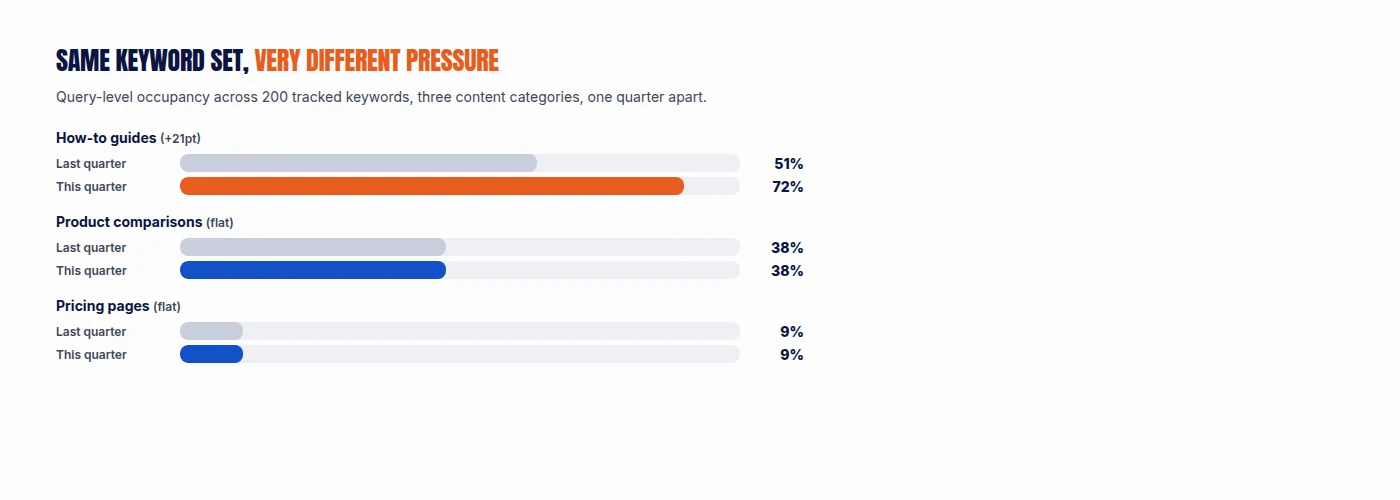
That trend alone tells you where to act. The how-to category is becoming more AI Overview-dominated quickly, and if your citation rate in that category hasn’t kept pace, and a citation-rate check should follow immediately after any occupancy check, that’s the clearest priority for new content investment. Pricing pages, with occupancy staying low and stable, don’t need the same urgency. The traditional ranking and CTR work already happening there is likely still doing most of the job.
FAQ
Is AI Overview occupancy the same as citation rate?
No. Occupancy measures how much of your keyword set or SERP space is claimed by AI Overviews in general, while citation rate measures whether your specific brand or domain is the one being cited when an AI Overview does appear. A topic can have high occupancy with your citation rate still at zero, which is precisely the combination that signals the most urgent content gap.
How do I calculate occupancy for my keyword set?
Divide the number of tracked keywords currently showing an AI Overview by your total tracked keyword count, sampled on a consistent schedule since AI Overview presence fluctuates over time and by query. Several SEO platforms now automate this calculation as part of standard rank tracking.
Why track occupancy separately from just watching my rankings?
Occupancy reveals where AI Overviews are consuming the most search visibility across your content categories, which helps prioritize where citation-focused content investment matters most, rather than treating every keyword’s AI Overview risk as equal.
Should I track query-level occupancy or pixel-level occupancy?
Ideally both, since they answer different questions. Query-level occupancy is easier to track and tells you how widespread AI Overview presence is across a keyword set. Pixel-level occupancy requires more specialized tooling but tells you how much visible space an AI Overview claims when it does appear, which matters for understanding how much organic visibility actually survives underneath it.