None of this replaces a traditional audit. It extends one, adding the layer of visibility that rank position alone no longer captures on its own. For the underlying concept behind the first two metrics, see what is AI Overview occupancy.
Metric 1: trigger rate
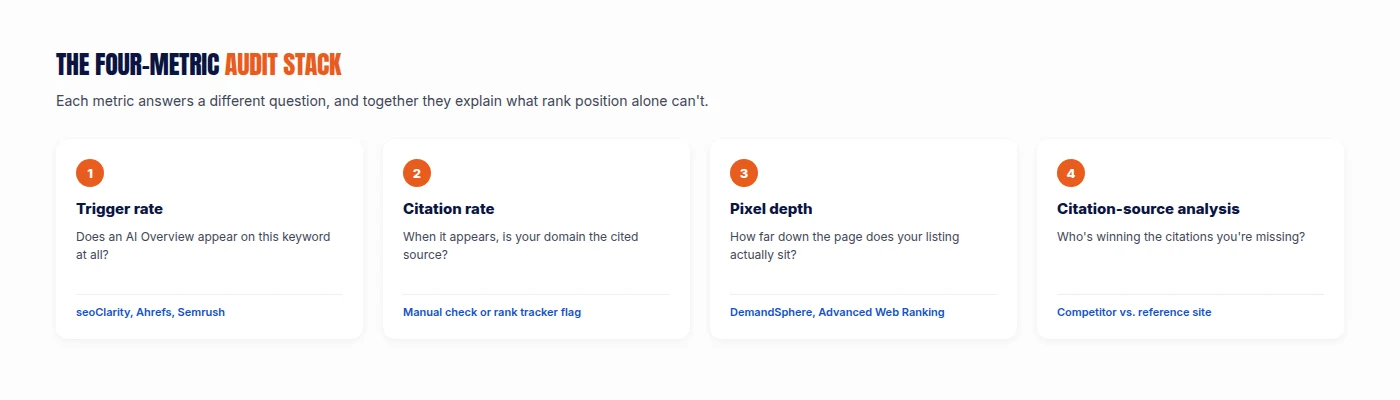
Start by finding out which of your target keywords currently show an AI Overview at all. The simplest method costs nothing: search each priority term in an incognito window and note whether an AI Overview appears. It’s slow at scale, but it’s a real, unfiltered look at what’s actually showing up.
For anything beyond a handful of terms, tool-based tracking is worth the cost. Semrush and Ahrefs both flag AI Overview presence directly in standard rank tracking now, and enterprise platforms like Rank Ranger, seoClarity, and Advanced Web Ranking offer the same at larger scale. Trigger rate tells you where the battlefield actually is. A keyword set with a low trigger rate doesn’t need much AI Overview-specific attention yet; one with a high trigger rate needs it immediately.
Metric 2: citation rate
Trigger rate tells you where AI Overviews show up. Citation rate tells you whether you’re winning when they do. Track, for each keyword where an AI Overview appears, whether your domain is named as a source.
This is the metric that diverges most sharply from traditional rank tracking, and it’s worth treating as its own line item rather than a footnote on a rankings report. A page can hold position one and still have a citation rate of zero on that exact query, a combination invisible to standard rank tracking but highly visible in real traffic numbers, a pattern examined in depth in can you rank #1 and still lose traffic to AI Overviews.
Metric 3: pixel depth or Visual Rank
Even a citation doesn’t tell the whole story if the surrounding SERP is dense enough to push everything below the fold regardless. Pixel depth measures the actual vertical distance from the top of the results page to your listing, accounting for the AI Overview, ads, and any other features stacked above it. See why AI Overviews push organic results further down for the pixel-height data behind why this matters.
DemandSphere’s Visual Rank, seoClarity’s Visibility Share, and Advanced Web Ranking’s pixel tracking all offer this as a standing metric. It’s the piece that explains why two keywords with identical ordinal rankings can produce very different real-world traffic, since the actual on-page depth of a “position 1” listing varies enormously depending on what’s competing for space above it.
Metric 4: citation-source competitive analysis
For the keywords where you’re not being cited, find out who is. That answer changes what you should actually do about it.
If direct competitors are winning the citations, the fix is a content and authority problem you can address directly: sharper, more extractable content and stronger topical signals on your own site. If the citations are going to reference sites instead, Wikipedia, Reddit, YouTube, and similar platforms account for a meaningful share of AI Overview citations across most industries, the fix looks different. It’s less about outranking a competitor and more about how your brand is discussed on platforms you don’t own, which calls for a different kind of effort entirely, including digital PR, community engagement, and earned mentions.
Running this analysis before choosing tactics saves real time. A content rewrite won’t fix a Reddit visibility problem, and a Reddit strategy won’t fix a competitor out-citing you with sharper content.
Building this into a recurring cadence
AI Overview presence and citation patterns shift faster than traditional rankings, so a one-time audit goes stale quickly. Weekly monitoring is worth the effort for your highest-priority terms, the ones driving the most traffic or revenue. Monthly checks are usually sufficient for the broader keyword set, where the cost of missing a short-term fluctuation is lower.
A simple audit checklist
Pull your priority keyword list and check AI Overview presence for each, either manually or through a rank tracker that flags it. Record citation status for every keyword where an AI Overview appears. Check pixel depth or Visual Rank for your top revenue-driving terms specifically, where the gap between ordinal rank and real visibility matters most. Identify who’s winning the citations you’re not, and categorize each as competitor or reference-site to guide the next step. Set a recurring cadence, weekly for priority terms, monthly for the rest, and track trend direction over time rather than treating any single check as final.
Reporting this to clients and stakeholders
Frame it as an addition to the ranking report, not a replacement. Most stakeholders already understand rank position, so introduce citation rate and pixel depth as context that explains traffic patterns their existing rank report can’t, rather than asking them to abandon a metric they already trust.
A simple before-and-after framing tends to land well: “You’re ranking #1 for this term, but here’s why traffic doesn’t match that position, and here’s what we’re doing about the gap.” That keeps the report grounded in something familiar while introducing the new layer of information they actually need. For the content-side fixes once you know where the gaps are, see how to optimize content for AI Overviews.
FAQ
What tools can track AI Overview presence and citation for my keywords?
Several SEO platforms now include AI Overview detection directly in rank tracking, including Semrush, Ahrefs, and enterprise tools like seoClarity, DemandSphere, and Advanced Web Ranking. The enterprise tools also offer pixel-depth or Visual Rank metrics that go beyond simple presence detection.
How often should I check AI Overview visibility for my priority keywords?
Weekly monitoring is generally recommended for high-priority terms, given how quickly AI Overview presence and citation patterns can shift. Monthly checks are usually sufficient for a broader, lower-priority keyword set.
Is citation rate more important to track than traditional keyword rankings?
Not instead of, but alongside. Traditional rankings still matter for informing citation eligibility and for query types where AI Overviews don’t appear, but citation rate captures a distinct and increasingly important dimension of visibility that ranking position alone no longer reliably predicts.
How do I know whether to fix my content or focus on off-site authority when I’m losing citations?
Check who’s actually winning the citations you’re missing. If it’s direct competitors, the fix is usually sharper, more extractable content and stronger on-site authority signals. If it’s reference sites like Wikipedia, Reddit, or YouTube, the fix looks more like earned mentions and community presence, since those platforms account for a meaningful share of AI Overview citations across most industries regardless of how strong any single competitor’s content is.